
How data center demand is reshaping electricity costs across the US
Published 12:30 pm Monday, November 9, 2026
Three years ago, U.S. utilities expected peak electricity demand to grow by about 24 gigawatts over the following five years. Their most recent forecasts put that figure at roughly 166 gigawatts, 6.9 times the earlier estimate, and about 90 gigawatts of the increase is tied to data centers. That growth is beginning to show up in electricity costs for businesses and households, though the effect looks very different depending on where a customer is located.
Data centers used about 4.4% of U.S. electricity in 2023, according to Lawrence Berkeley National Laboratory, and the lab projects that share could reach 6.7% to 12% by 2028. The U.S. Energy Information Administration expects record national electricity sales in 2026, driven by data center development and manufacturing, with the average U.S. residential price rising from 17.3 cents per kilowatt-hour in 2025 to 18.2 cents in 2026.
Whether data centers raise costs in a given area depends on three things:
- How much spare power supply the region had before they arrived
- How its electricity market recovers the cost of new demand
- What rules regulators have set for very large customers
Before looking at how those factors play out region by region, it helps to understand how data center demand turns into charges on an electricity bill.
For instance, if you’re doing business in Pennsylvania, Ohio, Maryland, or D.C., capacity charges are now one of the fastest-growing parts of commercial electricity bills in the PJM region. Below, Shipley Energy explains what the latest auction results mean for your next budget.
How Data Center Demand Reaches Electricity Bills
A large data center campus can need as much power as a small city, running around the clock. Grid operators and utilities have to secure generation and build transmission for that demand, often years before the facility opens. Those costs reach customers through three main channels.
The first is capacity costs, which pay power plants to be available during the hours when demand peaks. Some regions buy this capacity through auctions held years in advance, so forecasts of future data center demand can raise prices before the facilities exist. The second is wholesale energy prices, which rise when added demand calls more expensive power plants into service. Researchers at the Federal Reserve Bank of Dallas estimate that existing data centers have already raised wholesale electricity prices by 2% to 6% on average nationwide. The third is transmission and distribution, the lines and substations needed to deliver power to new load, which are often paid for by all customers in a utility’s territory.
Because wholesale power typically makes up about half of the retail price of electricity, a given increase in wholesale prices reaches retail bills at roughly half its size.
A Region-by-Region Look
The same kind of demand growth is producing very different results across the country.
PJM
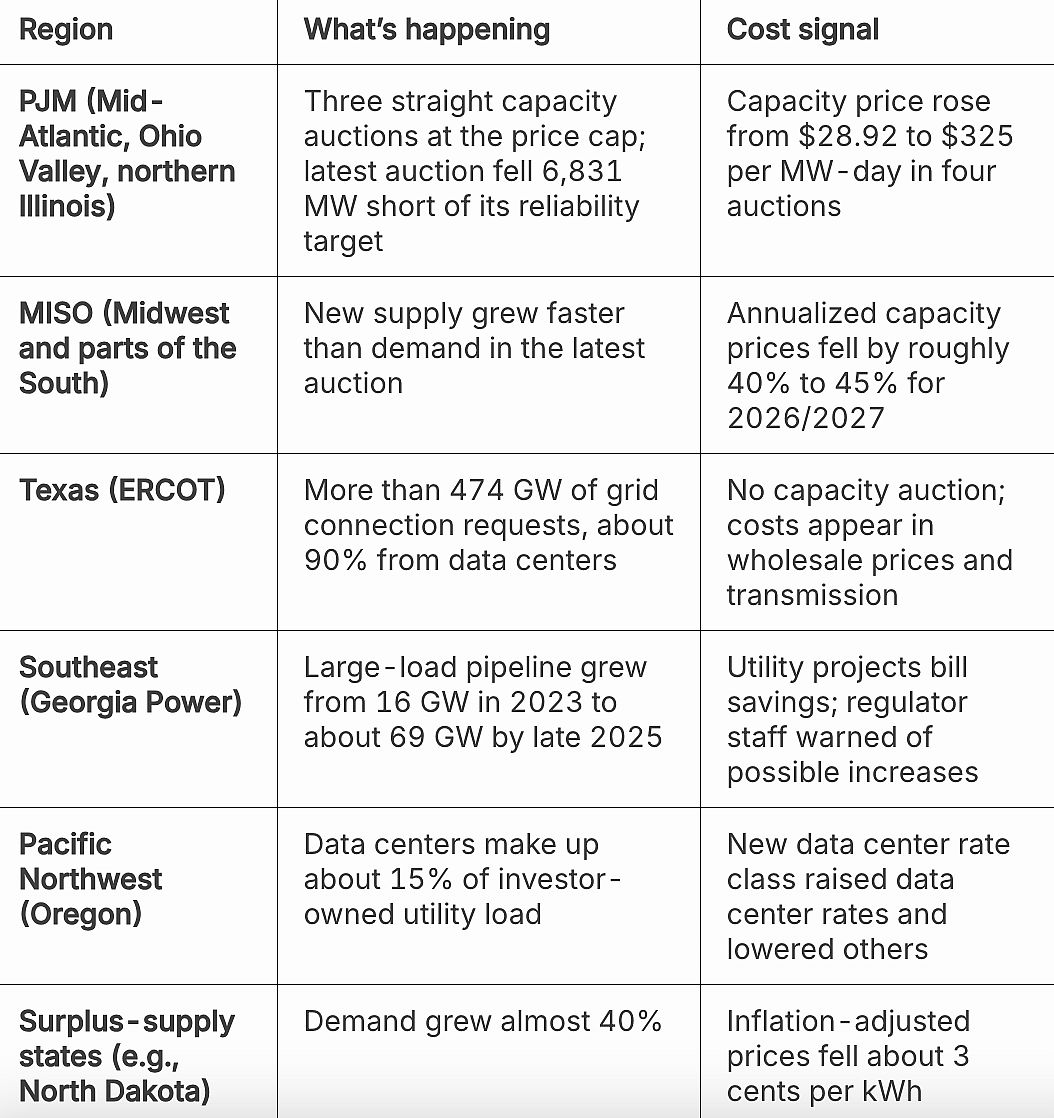
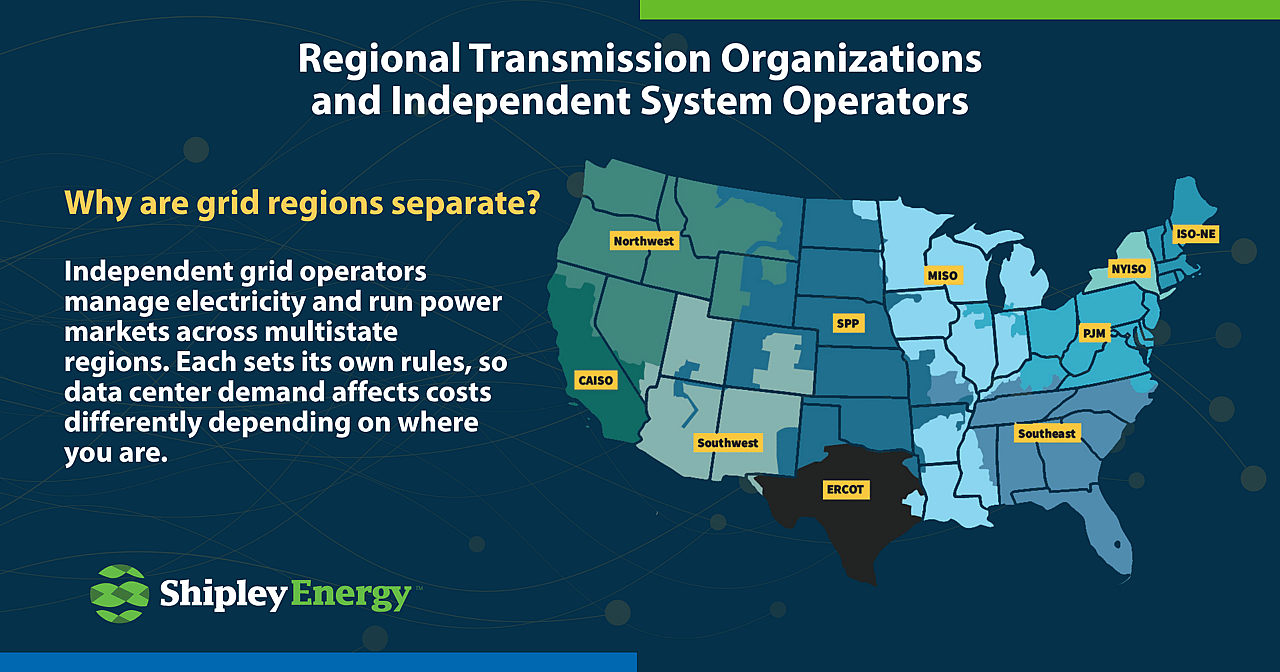
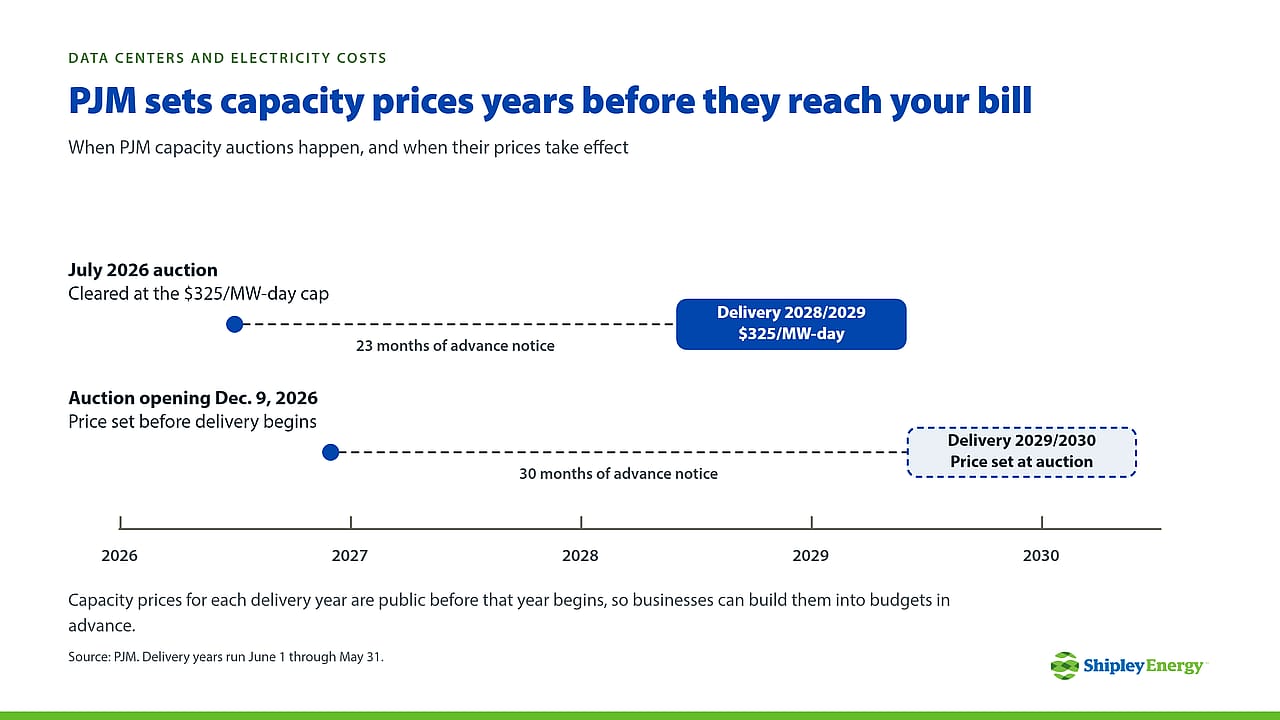
The grid operator serving 13 states and Washington, D.C., runs a capacity auction about three years ahead of delivery. Its clearing price rose from $28.92 per megawatt-day for 2024/2025 to $269.92 for 2025/2026, then hit a federally approved cap in each of the next three auctions. The 2028/2029 auction cleared at $325 per megawatt-day and still came in 6,831 megawatts short of PJM’s reliability requirement. PJM’s independent market monitor attributes about 46% of capacity costs across the last four auctions, or $29.4 billion, to data center demand.
MISO
The Midcontinent grid operator saw summer capacity prices reach a record $666.50 per megawatt-day for 2025/2026 as its surplus shrank. A year later, the picture shifted. Capacity offered into the 2026/2027 auction grew 3.4%, led by solar additions, and annualized prices fell to between $116 and $126 per megawatt-day, down from $212 to $217 the year before.
Texas
ERCOT has no capacity auction, so data center demand shows up mainly in wholesale prices during high-demand hours and in transmission spending. In August 2026, Gov. Greg Abbott directed state regulators and ERCOT to audit every data center seeking a grid connection before any project moves forward, citing more than 474 gigawatts of requests, more than five times the state’s record peak demand, with about 90% coming from data centers.
Southeast
Georgia Power’s pipeline of prospective large-load projects grew from about 16,000 megawatts in 2023 to roughly 69,000 megawatts by December 2025, about 80% of it from data centers. The utility and its regulators disagree on the electricity bill impact. Georgia Power projects that new large-load contracts will produce about $950 million a year in customer savings beginning in 2029, while state commission staff cautioned that the related generation buildout could add around $20 a month to residential bills.
Pacific Northwest
Data centers account for roughly 15% of the current load of Oregon’s investor-owned utilities, according to the state’s utility commission. Under a 2025 state law, Oregon regulators approved new rates for Portland General Electric in July 2026 that raised data center rates by an average of 29% while lowering residential rates by 1.3% and commercial rates by 2.1%.
Surplus-Supply States
In states that had extra generation before data centers arrived, new demand has often spread fixed grid costs across more customers. North Dakota saw electricity demand grow almost 40% while inflation-adjusted prices fell by about 3 cents per kilowatt-hour. Researchers at Lawrence Berkeley National Laboratory and The Brattle Group, who documented that pattern, describe the overall relationship between load growth and prices as mixed and uncertain in their 2026 update.
Forecasts Versus What Gets Built
Not every announced data center will be built, and forecasts disagree about how many will. Utility forecasts add up to about 90 gigawatts of new data center load by 2030, while data center market analysts estimate growth is unlikely to need much more than 65 gigawatts over that period. Part of the gap comes from developers submitting the same project to several utilities at once, which can lead to the same facility being counted more than once.
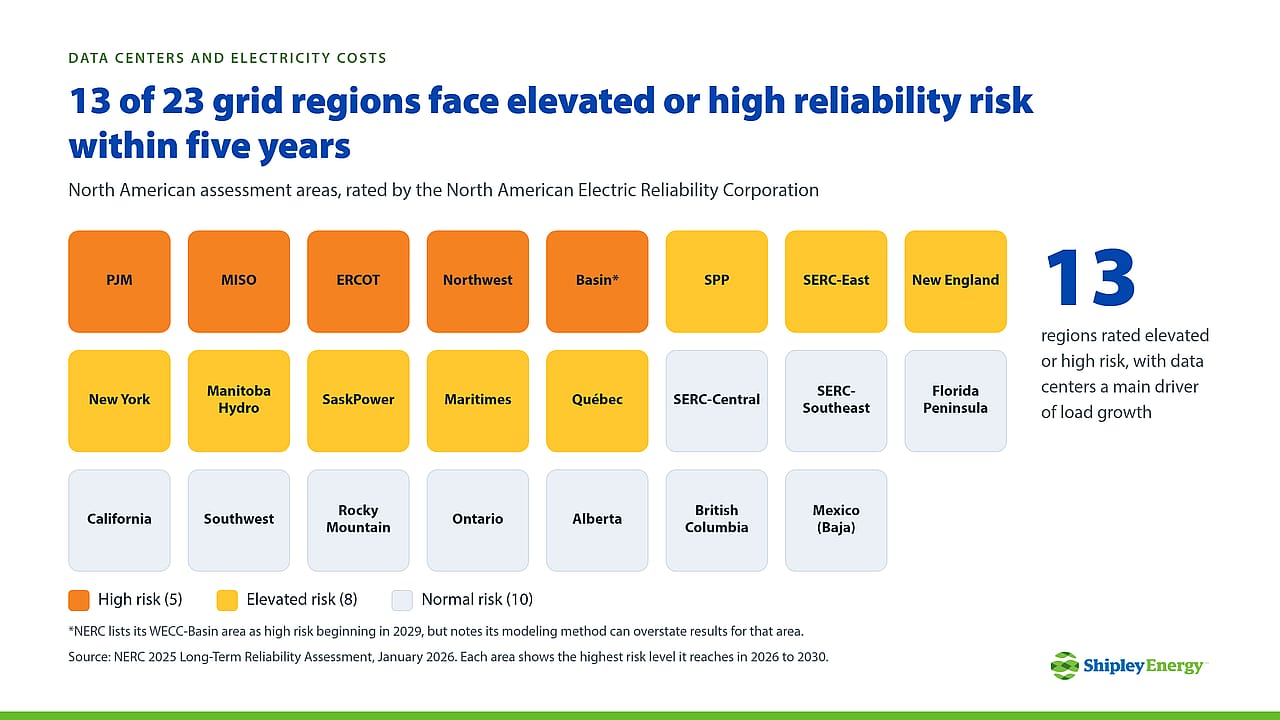
The North American Electric Reliability Corporation, which oversees grid reliability, found that 13 of 23 North American assessment areas face elevated or high risk of supply shortfalls within five years, with data centers as a main driver of load growth. PJM, MISO, ERCOT, and two western regions are rated high risk. Grid Strategies, the consulting firm behind the national load forecast figures, has argued that NERC’s assessment overstates the risk by overestimating how much data center load will connect.
The debate matters for costs. In markets like PJM, capacity is purchased against forecasts years in advance, so the accuracy of those forecasts directly affects what customers pay.
Why New Supply Is Slow to Follow
High prices usually attract new power plants, but the response has been limited so far. PJM’s 2028/2029 auction cleared only 525 megawatts of new generation and plant upgrades despite a record price. Equipment is one constraint. The major manufacturers of heavy-duty gas turbines are booking delivery slots four to five years out, and GE Vernova alone reported 116 gigawatts of gas turbine orders and reservations in mid-2026. Permitting, siting, and supply chain issues add further delays.
The Natural Gas Connection
Data center demand also ties electricity costs more closely to natural gas. In PJM, natural gas plants produced about 44% of the region’s electricity in 2024, so gas prices weigh heavily on wholesale power prices. Data centers run at a steady rate year-round, which means their demand stacks underneath winter heating demand rather than easing when temperatures drop.
Winter Storm Fern in January 2026 showed how quickly that can tighten markets. The Henry Hub natural gas spot price set an all-time daily record of about $30.57 per million British thermal units on Jan. 26. Day-ahead power prices at PJM’s Western Hub cleared at $2,323 per megawatt-hour the next day. The U.S. Department of Energy issued an emergency order allowing PJM to direct data centers and other large facilities onto backup generation as a last resort to prevent blackouts.
How States Are Responding
States are increasingly setting separate rules for very large electricity users, with the goal of keeping data center infrastructure costs from shifting onto other customers. Common tools include dedicated rate classes, minimum monthly charges, long-term contracts, collateral requirements, and exit fees.
Ohio regulators approved a tariff in July 2025 requiring new AEP Ohio data centers above 25 megawatts to pay for at least 85% of their subscribed capacity for up to 12 years, regardless of actual use. Virginia regulators created a new rate class for Dominion Energy customers requiring 25 megawatts or more, effective in 2027. Oregon’s 2025 law created a separate class for data centers above 20 megawatts, and Georgia now requires the state commission to review Georgia Power’s large-load contracts. Texas has paused new data center connections pending its audit.
The approach is not without debate. The Data Center Coalition, an industry group, has called some of Oregon’s rules out of step with other states.
What Data Center Demand Means for Business Energy Buyers
For businesses, the most visible change in some regions has been growth in the capacity and transmission portions of commercial electricity bills, which were relatively minor line items for many years. In capacity-market regions like PJM, those charges are set by public auctions with known schedules, so operators can see them coming years in advance and factor them into budgets.
Contract structure has become a larger part of the conversation. Many commercial electricity contracts lock in the energy price while passing capacity and transmission costs through at whatever the market sets. Facilities that reduce usage during the grid’s highest-demand hours can lower their share of those costs, and demand response programs pay participants to cut usage during grid emergencies. Regional context matters as well: A business in a surplus-supply area faces different risks than one in PJM or ERCOT.
Where Costs Go From Here
Data center demand is large and still growing, but its effect on electricity costs depends on local supply, market design, and the choices regulators make. Regions where forecasts are rising faster than new generation, and where costs are spread broadly across customers, are where price pressure has been most visible so far. Regions with spare capacity, or with rules that assign more costs directly to large users, have seen a more muted effect.
This story was produced by Shipley Energy and reviewed and distributed by Stacker.